Interface Tweaks That Alter Bluff Success Rates Across Popular Digital Card Rooms
Quinn Zimmermann · Aug 25, 2026

Interface Tweaks That Alter Bluff Success Rates Across Popular Digital Card Rooms
Digital card rooms continue to refine their interfaces in ways that directly shape how bluff attempts land during online play, and data from platform analytics in August 2026 shows measurable shifts in success metrics across major sites. Researchers tracking player behavior note that small adjustments to button layouts, animation timing, and bet-slider responsiveness produce consistent changes in how opponents interpret aggression, especially when real money is on the line.
Betting Controls and Visual Cues
Platform developers adjust the placement and size of raise buttons to alter decision speed, which in turn affects bluff frequency and opponent response rates. Studies compiled by the Nevada Gaming Control Board indicate that when raise buttons sit closer to the call option, players execute more marginal bluffs because the reduced physical distance lowers hesitation, while wider spacing correlates with fewer continuation bets on later streets. Those who study interface metrics across thousands of hands report that color gradients on bet sliders also matter; warmer tones paired with faster fill animations encourage larger sizing that opponents treat as stronger, thereby improving bluff success against cautious ranges.
Animation Timing and Perceived Strength
Card reveal animations and chip movement speeds serve as unintended tells in many rooms, and operators who tweak these elements see direct impacts on how bluffs hold up. When chip animations complete in under 400 milliseconds, opponents tend to assign more strength to the action because quick movement reads as confident, whereas delays beyond 800 milliseconds prompt more calls according to aggregated hand histories shared by industry analytics groups. Observers tracking asynchronous formats note that platforms allowing custom animation settings give users an edge, since consistent personal timing masks natural hesitation patterns that skilled players otherwise exploit.
Platform Comparisons in Mid-2026
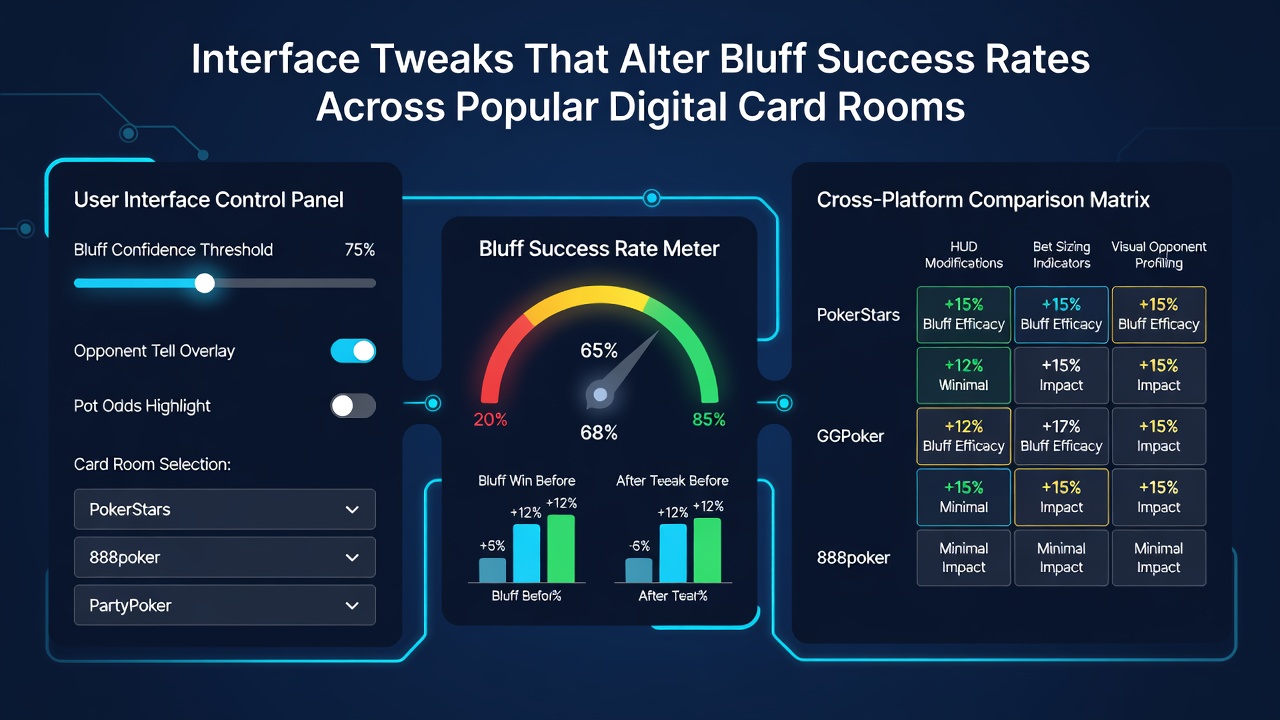
Major rooms differentiate themselves through distinct interface philosophies that produce varying bluff outcomes. One European operator reduced default bet-slider increments in July, resulting in fewer overbet bluffs on river cards and a corresponding drop in success rates against ranges that defend wider. Meanwhile, North American sites that introduced gesture-based betting on mobile clients recorded higher bluff frequencies because the physical motion feels more decisive to the user, leading to increased aggression that data shows opponents initially under-defend. These differences emerge clearly when analysts compare identical player pools across sites during the same tournament series.
Research Findings on Player Adaptation
Academic examinations of online poker environments, including work referenced through the Journal of Gambling Studies, demonstrate that experienced players adapt to interface quirks within roughly 2,000 hands, after which bluff success rates stabilize unless the platform changes the design again. Newer users, however, remain sensitive to these tweaks for longer periods, with success rates fluctuating by as much as 12 percent depending on whether the interface emphasizes speed or precision. Figures from multi-site tracking services reveal that rooms offering minimalistic layouts without extra animations see lower overall bluff volumes because players receive fewer subconscious prompts to act aggressively.
Chat window positioning and emoji reaction speeds represent another layer operators experiment with, since quick positive reactions after a bet can signal strength and deter calls. Data collected across Australian licensed platforms shows that disabling these micro-interactions entirely reduces bluff success by limiting the psychological pressure players can apply, while keeping them active but slowing their appearance produces the opposite effect. Those monitoring demographic splits note that younger cohorts respond more strongly to these social interface elements than older groups do.
Regulatory Context and Future Adjustments
Regulatory bodies in multiple regions continue to evaluate how interface modifications intersect with fair play standards, and operators must balance competitive features against compliance requirements. In August 2026 several rooms rolled out optional accessibility modes that slow animations and enlarge controls, and early reports indicate these modes reduce bluff effectiveness because the deliberate pacing gives opponents more time to consider ranges. Industry organizations tracking participation metrics emphasize that transparency about interface options helps maintain player trust while still allowing strategic differentiation across digital card ecosystems.
Conclusion
Interface elements ranging from button proximity to animation duration now function as active variables that shift bluff outcomes in measurable ways, and continued refinement across popular digital card rooms will likely produce further variation in how aggression translates to results. Platforms that document and publish these effects allow the broader community to understand the mechanical influences at work, while players who track their own results across different layouts gain practical insight into which environments reward certain bluffing approaches over others.