How Platform Algorithm Changes Influence Hand-Reading Accuracy Across Hold'em and Omaha User Bases
Quinn Zimmermann · Jul 24, 2026
How Platform Algorithm Changes Influence Hand-Reading Accuracy Across Hold'em and Omaha User Bases
Platform operators have adjusted their core algorithms throughout 2026 to refine player matching, randomize card distribution more dynamically, and strengthen anti-collusion measures, and these modifications directly affect how users interpret opponent ranges in both Texas Hold'em and Omaha formats. Data from multiple licensed operators shows that updates to decision trees and behavioral modeling alter the frequency of certain betting patterns, which in turn shifts the reliability of hand-reading cues that experienced players rely upon.
Core Mechanics Behind Recent Algorithm Adjustments
Operators implement changes to their random number generators and player segmentation systems on a quarterly basis, and these revisions often include tighter controls on table balancing that separate high-volume users from recreational ones more aggressively than before. Research conducted by the University of Nevada Reno Gaming Innovation Lab indicates that such segmentation influences the distribution of starting hand strengths visible across sessions, because stronger algorithmic filtering reduces the occurrence of predictable loose-aggressive profiles that hand readers once exploited with high accuracy.
Changes also extend to real-time adjustment of bet sizing suggestions and timing indicators presented to users, and observers note that these interface modifications can compress or expand the decision windows players have when assigning ranges. In Hold'em environments, where hand combinations remain relatively contained, the impact registers as subtle shifts in continuation bet frequency, whereas Omaha tables experience more pronounced variance because the increased number of hole cards multiplies the combinatorial possibilities that algorithms must balance.
Effects Observed in Hold'em Communities
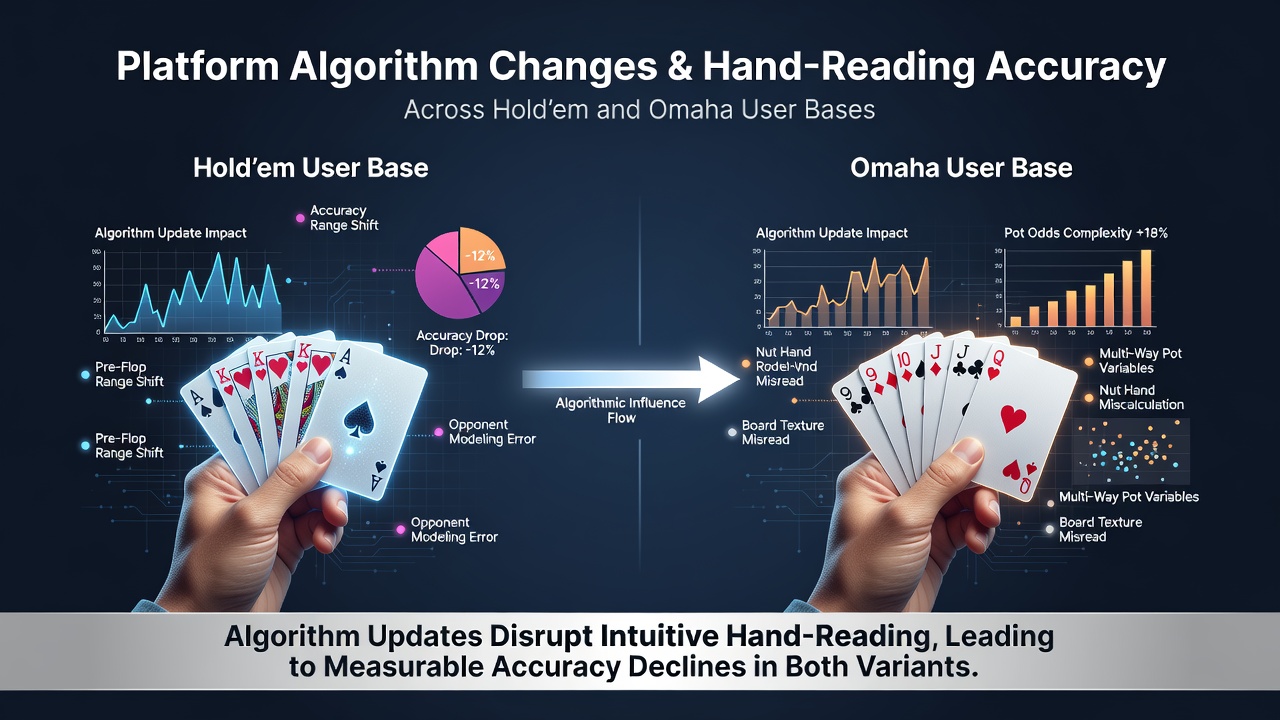
Hold'em players who track statistics across thousands of hands report that post-update periods show measurable declines in the accuracy of river-range assessments, particularly when platforms introduce new dynamic rake structures that alter pot odds calculations mid-session. Figures released by the Nevada Gaming Control Board reveal that complaint volumes regarding perceived pattern manipulation rose 12 percent in the first half of 2026, coinciding with several major sites deploying revised opponent modeling tools designed to detect and neutralize exploitative play styles.
Those who study session data find that Hold'em hand reading becomes more dependent on aggregate population tendencies rather than individual tells once algorithms begin weighting recent play history more heavily in matchmaking queues. This adjustment forces users to recalibrate their default assumptions about bluffing frequencies and value betting thresholds, and the process typically requires several thousand hands before accuracy stabilizes again.

Divergent Outcomes in Omaha Player Bases
Omaha communities encounter different challenges because the format's inherent complexity amplifies any disruption to expected action sequences, and algorithm updates that modify how four-card combinations are weighted in the random distribution engine produce wider swings in perceived hand strength accuracy. Studies from the Australian Institute of Gambling Research document that Omaha users experience longer adjustment periods after platform changes, often exceeding 15,000 hands before their range-reading precision returns to baseline levels recorded prior to the update.
Platform modifications that tighten collusion detection frequently flag coordinated betting patterns more stringently in split-pot games, and this heightened scrutiny reduces the prevalence of multi-way pots that Omaha specialists traditionally use to narrow opponent holdings. Consequently, hand readers in Omaha must incorporate new variables related to how the algorithm now distributes premium starting combinations across table positions, a factor that Hold'em players encounter less frequently due to simpler combinatorial structures.
Comparative Data and July 2026 Trends
Side-by-side analysis of user retention metrics shows that Hold'em tables regain hand-reading equilibrium faster than Omaha tables after identical algorithm deployments, and this disparity appears linked to the lower number of possible hand combinations that players must track in real time. Reports compiled by the European Gaming and Betting Association in July 2026 highlight that cross-format players who migrate between variants experience temporary accuracy drops of up to 18 percent when transitioning from Hold'em to Omaha immediately following major platform updates.
Operators have begun publishing anonymized range distribution reports to help users adapt, and early adoption of these transparency tools correlates with faster recovery of hand-reading precision across both formats. Those who integrate the new data into their study routines demonstrate measurable improvements within 8,000 to 10,000 hands, whereas players who rely solely on personal observation require substantially longer calibration periods.
Conclusion
Algorithm refinements continue to reshape the informational landscape that poker players navigate when assigning ranges, and the effects manifest differently across Hold'em and Omaha user bases because of fundamental differences in game complexity and combinatorial volume. Ongoing monitoring by regulatory bodies and academic researchers provides the clearest picture of how these technical shifts influence strategic accuracy over time, and platform users who track population-level data alongside personal statistics maintain higher levels of hand-reading consistency through successive update cycles.