Examining how time zone differences shape decision timing and risk assessment patterns among hold'em and omaha participants across global online platforms
Quinn Zimmermann · Jul 21, 2026
Examining how time zone differences shape decision timing and risk assessment patterns among hold'em and omaha participants across global online platforms
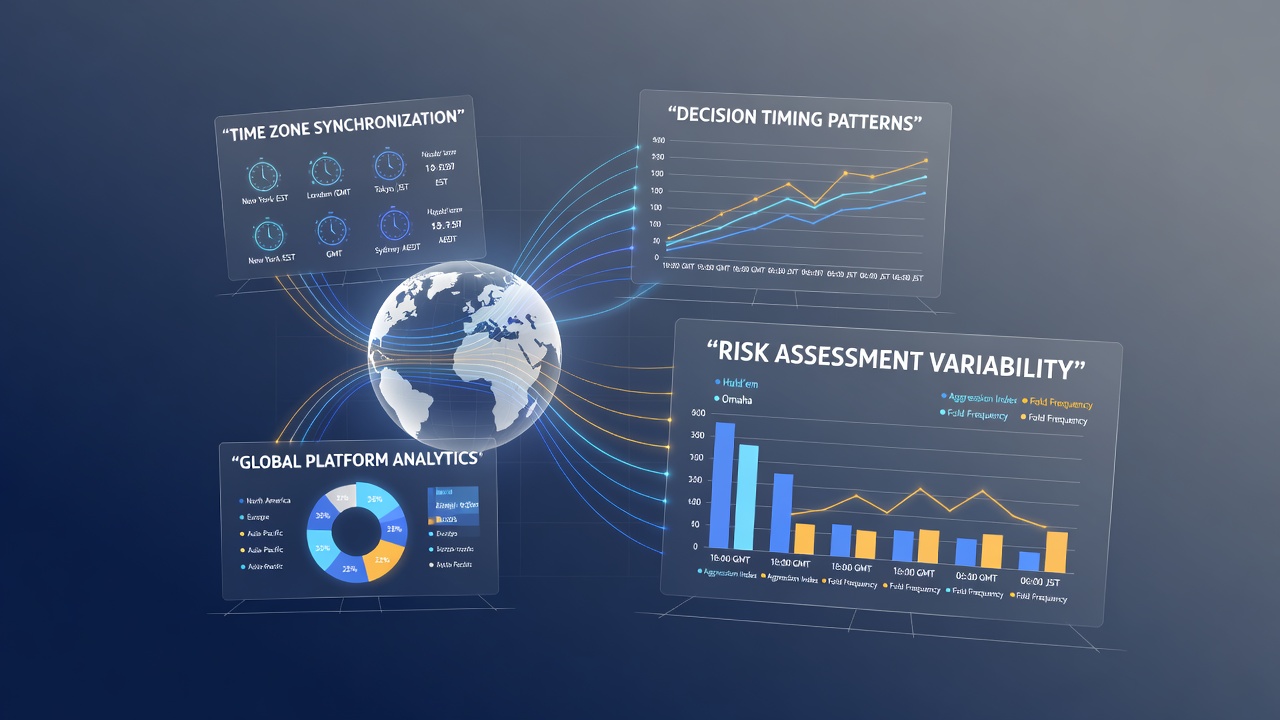
Time zone differences create distinct windows of activity that influence when hold'em and omaha participants log in and how they approach each hand, with data from major platforms showing clear shifts in session lengths and action frequency tied to regional clock times. Players in the Asia-Pacific region often enter tables during evening hours that align with North American mornings, and this overlap produces measurable changes in betting speed and pot commitment levels. Researchers tracking millions of hands across sites have noted that decision intervals stretch longer when participants operate outside their local daylight periods, particularly in formats where multiple cards must be evaluated simultaneously.
Distribution of Players Across Regions
Online platforms host participants from more than 150 countries, yet peak traffic clusters around four primary time blocks that correspond to evening leisure hours in Europe, North America, East Asia, and Australia. Hold'em tables fill rapidly during these overlapping periods while omaha games, which require greater mental calculation, see steadier but lower-volume participation. Figures released by the American Gaming Association in early 2026 indicated that roughly 38 percent of multi-table traffic occurs when at least two major regions are simultaneously active, and this pattern held steady through July of the same year.
Effects on Decision Timing
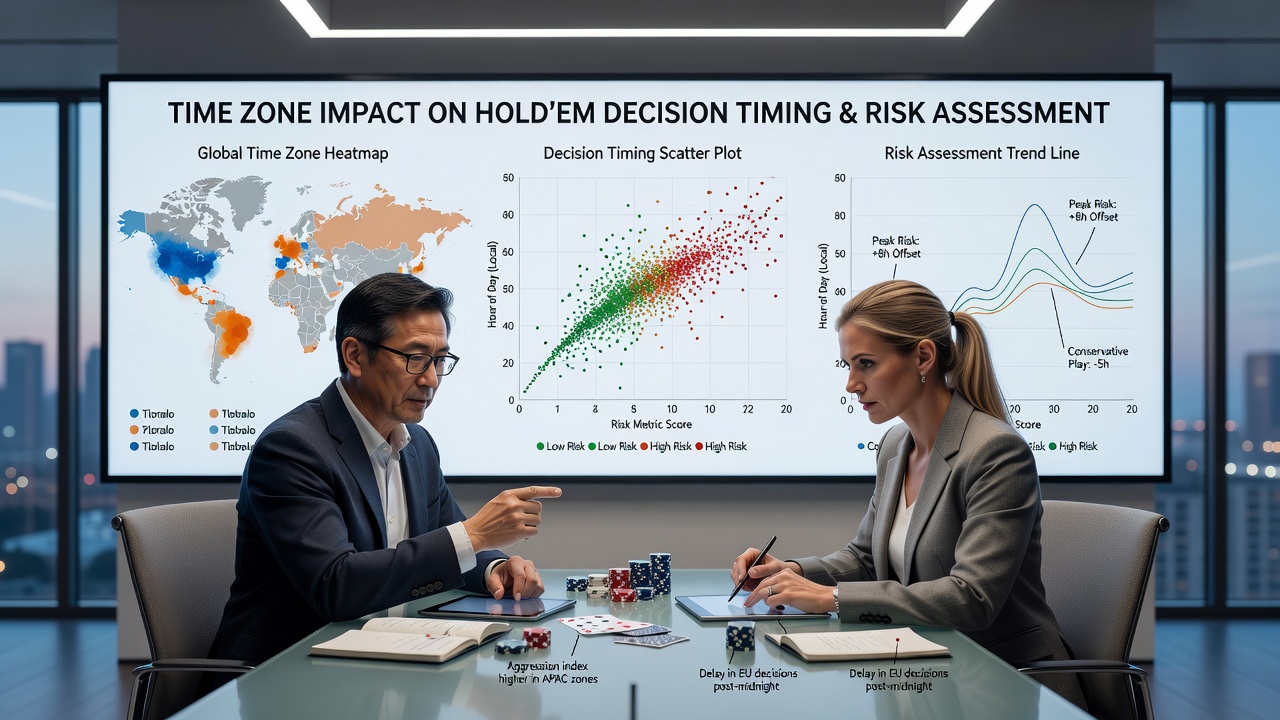
Decision timing varies with circadian alignment, and platform logs reveal that average action speed slows by 12 to 18 seconds per street when a player’s local time falls between 2 a.m. and 6 a.m. In hold'em, pre-flop folds happen more quickly during these windows because fewer marginal hands enter play, whereas omaha participants take additional seconds to reassess four-card combinations under fatigue. Studies published in the Journal of Gambling Studies have documented these delays across thousands of sessions, linking them to reduced working memory capacity rather than changes in strategy intent. And yet the same records show that players who remain active through multiple time-zone handoffs maintain consistent timing once they adjust to the new overlap.
Risk Assessment Patterns in Different Zones
Risk assessment also shifts according to the hour, with aggression metrics rising during late local sessions for both variants. Hold'em participants post larger continuation bets when their home clocks read past midnight, while omaha players increase three-bet frequencies in the same windows, according to aggregated data from European regulatory reports compiled in 2025 and 2026. These adjustments appear tied to reduced loss aversion rather than deliberate style changes, and they reverse once participants return to standard waking hours. Observers note that the effect appears stronger in omaha because the larger number of possible holdings amplifies the impact of any momentary lapse in evaluation.
Platform Trends Observed in July 2026
During July 2026, several networks reported a 9 percent increase in cross-zone omaha traffic compared with the prior month, coinciding with summer vacation schedules in the northern hemisphere. Hold'em volume remained stable, yet average stack depths at tables that bridged Asian and European hours grew by nearly 15 big blinds. These patterns emerged without corresponding changes in overall player counts, suggesting that existing participants simply extended their sessions across time-zone boundaries. Industry reports from the Canadian Centre for Gaming Research confirm similar summer spikes in previous years, reinforcing the link between seasonal leisure time and extended multi-zone play.
Comparative Impact on Hold'em Versus Omaha
Hold'em and omaha respond differently to the same time-zone pressures because of structural distinctions in hand strength and implied odds. Hold'em players can reach decisions faster when tired because fewer variables require calculation, yet they also display sharper drops in post-flop aggression once local time exceeds typical bedtime. Omaha participants, by contrast, maintain higher variance in bet sizing throughout extended sessions, a pattern attributed to the greater number of drawing combinations that remain viable even under reduced cognitive load. Data collected from North American-facing servers shows that omaha win rates for players logging in from distant zones fluctuate more widely than equivalent hold'em figures, although overall profitability does not diverge significantly between the two games.
Conclusion
Time zone differences produce measurable, consistent effects on both decision timing and risk assessment among hold'em and omaha participants worldwide, and platform data from 2026 continues to map these influences across regions. The patterns remain stable enough that operators can anticipate traffic surges and adjust table offerings accordingly, while participants who track their own hourly performance gain clearer insight into when their edge changes. As global online poker continues to connect distant markets, these temporal dynamics will shape how both games evolve in the coming years.